


How to Find Reliable Cosmetics Manufacturers in China (2026 Guide)

Why China Leads Global Cosmetics Manufacturing
China has become the backbone of global skincare and cosmetics production, not just because of cost advantages, but due to a highly mature industrial system.
1. Full Supply Chain Integration
From raw materials, formulation labs, packaging, filling, to labeling—China offers a complete end-to-end cosmetics ecosystem.
2. Scalable OEM/ODM Infrastructure
Modern factories can support:
- Startup brands (small batch private label)
- Mid-size DTC brands (custom formulations)
- Large retail chains (mass production)
3. Advanced Manufacturing Standards
Leading manufacturers operate under:
- GMPC (Cosmetic GMP)
- ISO 22716
- FDA compliance support for US export
- BSCI ethical production audits
👉 Example: GMP-certified manufacturers like Guangdong Joyan Biological Technology integrate R&D, formulation, testing, and automated production lines under one facility system.
OEM vs ODM: What’s the Difference?
Understanding this is critical before choosing a supplier.
OEM (Original Equipment Manufacturing)
You provide:
- Formula or concept
- Branding + packaging
Factory provides:
- Production only
Best for:
👉 Brands with existing product ideas
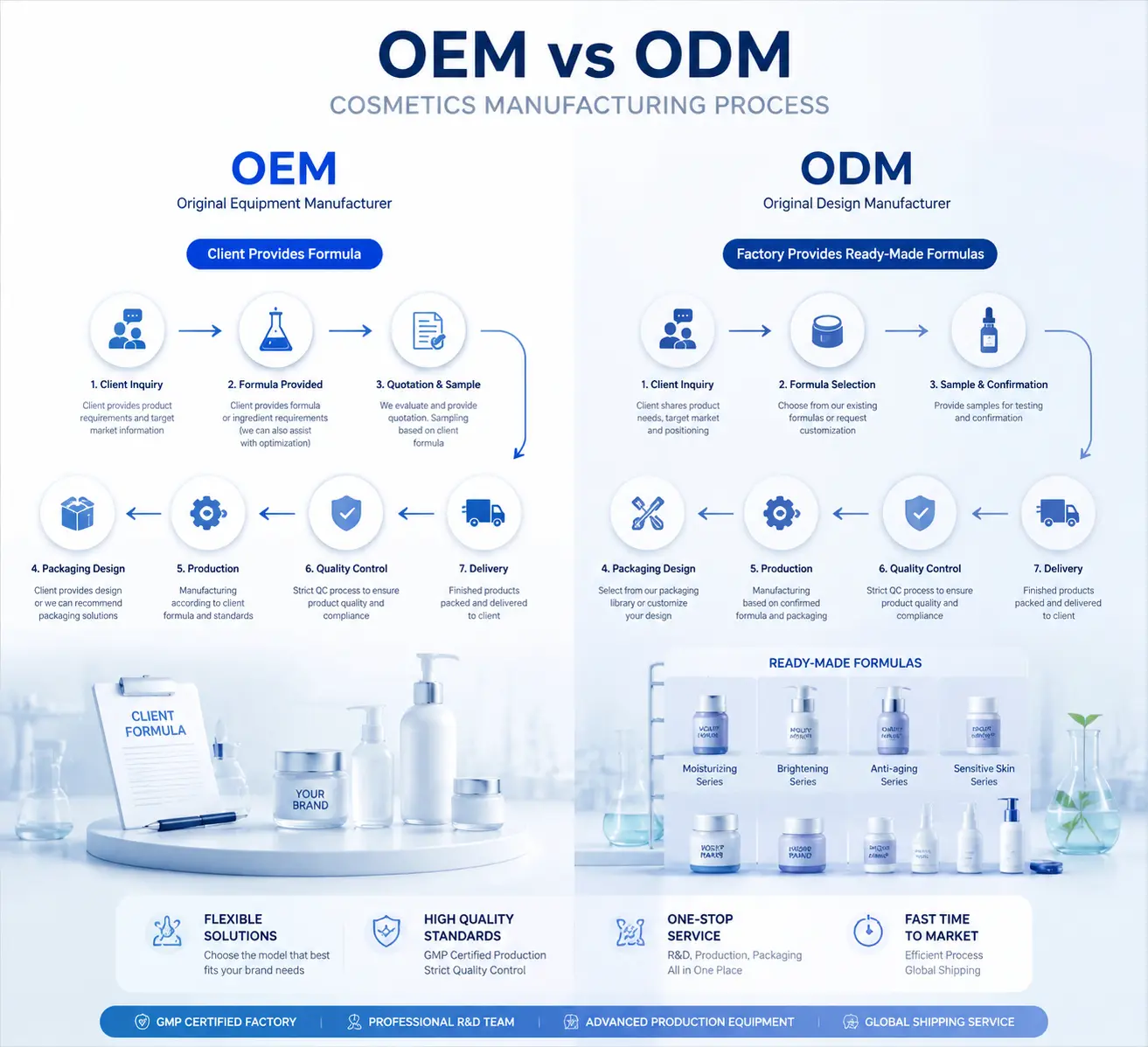
ODM (Original Design Manufacturing)
Factory provides:
- Ready-made formulas
- Packaging options
- Product concepts
You customize:
- Branding
- Positioning
- Minor formulation tweaks
Best for:
👉 Startups or fast-launch brands
How to Identify a Reliable Cosmetics Manufacturer in China
This is where most foreign brands make costly mistakes.
1. Verify Certifications (Non-negotiable)
A serious cosmetics factory should provide:
- GMPC certification (cosmetic safety standard)
- ISO 22716 compliance
- SGS or third-party lab testing
- FDA registration (for US market support)
- BSCI audit (ethical production)

⚠️ Red Flag:
If a supplier cannot provide verifiable documents → immediately discard.
2. Evaluate Real Production Capacity
Do not trust marketing claims—ask for actual numbers:
Key indicators:
- Daily production output
- Number of automated lines
- R&D team size
- MOQ per SKU
Example benchmark:
A mature factory like Joyan can produce hundreds of thousands of skincare units daily, including sheet masks and eye patches.
3. Check OEM/ODM Experience (Not Just Manufacturing)
Ask:
- Do they work with overseas brands?
- Can they support formulation customization?
- Do they offer packaging sourcing?
👉 True OEM factories act as “product development partners”, not just suppliers.
4. Communication Quality = Supplier Quality
Strong indicators of reliability:
- Fast response time (within 24h)
- Technical understanding of skincare ingredients
- Willingness to provide samples
- Transparent pricing structure
⚠️ Warning sign:
If communication is vague or inconsistent → high risk of production issues later.
Major Risks When Sourcing Cosmetics from China
Most beginners fail here.
1. Fake or Misleading Certifications
Some suppliers show copied or outdated certificates.
2. Extremely Low MOQ Offers
If MOQ is unrealistically low:
👉 likely reseller, not factory
3. Hidden Cost Structure
Common hidden fees:
- Packaging mold fees
- Formula development fees
- Stability testing fees
4. No R&D Capability
Factories without labs cannot support real customization.
Typical OEM/ODM Workflow in China

Understanding the process helps avoid delays and miscommunication.
Step 1: Product Brief
- Target market
- Skin concern
- Texture preference
Step 2: Formula Proposal
Factory provides:
- Base formula options
- Ingredient recommendations
Step 3: Sampling Phase
- 1–3 rounds of samples
- Texture + performance testing
Step 4: Packaging Design
- Bottle / jar / box selection
- Label compliance review
Step 5: Mass Production
- Raw material sourcing
- Filling + sealing + QC
Step 6: Shipping & Export
- Compliance documents
- Logistics coordination
Case Example: GMP Cosmetics Manufacturer in Guangdong
A typical high-standard manufacturer in Guangdong province (such as Joyan Biological Technology) offers:
- Integrated R&D + manufacturing facility
- Skincare product lines (mask, cream, serum, eye care)
- High-volume automated production lines
- International certifications for export markets
This type of structure reduces:
👉 supply chain risk
👉 communication delays
👉 quality inconsistency
Red Flags When Choosing a Cosmetics Supplier

Avoid suppliers that show:
- ❌ No factory address or unclear location
- ❌ Refusal to provide certifications
- ❌ Only WhatsApp/WeChat communication with no official email
- ❌ No sample policy
- ❌ Unrealistic pricing far below market
FAQ: Cosmetics OEM in China
Q1: What is the typical MOQ for cosmetics OEM in China?
Most professional factories require 1,000–5,000 units per SKU depending on product type.
Q2: How long does production take?
Typical timeline:
- Samples: 7–15 days
- Mass production: 25–45 days
Q3: Can I create a fully custom skincare formula?
Yes, but requires:
- R&D cost
- Stability testing
- Longer lead time
Q4: Are Chinese cosmetics safe for EU/US markets?
Yes, if produced in GMP/ISO-certified facilities with proper compliance documentation.

Final Recommendation
Finding a reliable cosmetics manufacturer in China is not about choosing the cheapest supplier—it is about selecting a production partner who can scale with your brand.
The best manufacturers combine:
- Certification compliance
- Stable production capacity
- Strong R&D capability
- Transparent communication
👉 Factories like Guangdong Joyan Biological Technology represent this new generation of integrated OEM/ODM partners.
Get Professional OEM Support
If you are planning to launch or scale a skincare brand, working directly with a qualified OEM/ODM factory can significantly reduce time, cost, and risk.
Next step options:
- Request product catalog
- Get OEM pricing & MOQ list
- Ask for sample formulation suggestions
- Discuss private label development
👉 Contact us to start your OEM skincare project today.
Contact us